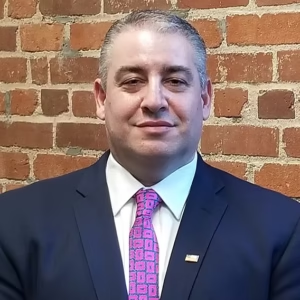
This podcast episode explores a powerful yet underutilized strategy for mortgage lenders to unlock new revenue and long-term enterprise value by launching their own title operations. David Lykken sits down with Joe D’Urso to break down how lenders, branches, and high-performing teams can move beyond traditional joint ventures and instead build fully owned, RESPA-compliant title businesses that generate recurring income while creating a sellable asset. The conversation dives into how this model enhances control over the customer experience, improves operational efficiency through modern technology, and opens the door to scalable growth—making it a compelling opportunity for lenders looking to maximize profitability in today’s competitive market.
[David] Folks, we’re all looking for ways to make more money, and today we’re gonna be talking about one opportunity that you have been missing out on, on revenue stream that you can make happen, and it creates a new franchise. Joining me today is Joe D’Urso CEO of TitleEase. Joe, good to have you here, man.
[Joe] Good to have you here, man. David, great to be with you. I appreciate it.
[David] I’m really excited about our listeners here. Go out this new opportunity. And we know the title of insurance has been a part of our business as long as I’ve been in for 52 years, but not many people are realizing they can set up their own title insurance agency. Some do. So let’s start off by talking about the broad concept and lenders being able to set up their own franchise, their own title operation. Let’s talk about that, explain what it’d be done.
[Joe] Yeah. So thank you for that. We created TitleEase, and the ability to help real estate companies and, and lenders in particular easily set up their own title agencies and we provide all the support to do that. We did that because I’d been a participant in joint ventures, you know, multiple times over my career. They were a little bit frustrating, a little bit clunky. I think even the big underwriters don’t really do them anymore because they were frustrating from everybody involved. So we created a franchise structure instead of the typical JV structure because we were able to ensure that ensure, first and foremost, it’s respite compliant and it, and it really needs to be RESPA compliant. We don’t wanna blow up anybody’s business. We don’t wanna blow up our own business. And so what we’ve essentially done is just made it simple. We provide all of the support to help get it up and running. We get people licensed with their own title agency. They brand it whatever way they want, they own it a hundred percent, and we share all of the title revenues with them in that structure. And so we continue to be, it’s not like a McDonald’s franchise where you get trained to make burgers and then you just go off and make the burgers and you pay a royalty fee. We actually stay with every transaction, and, and both sides do real requisite work, you know, on the title transaction. We just make it faster, easier to do. And so that’s the general concept.
[David] Okay. And the best part of this is that they own the business, they own the income stream, it’s their revenue stream. They own it, they can sell it. So not only are you creating a revenue stream in a new stream, you also are creating an asset. Let’s talk about that part ’cause I’m looking for the things, as we get more into this, I wanna look for the hooks to get anyone listening to this and going. Now that’s different. Never heard that before. So explain about how, what, when they’re getting their own originations to use their own title insurance company or their franchise. Is it, it’s two separate corporations, you literally set up a separate corporation. Am I correct, Joe?
[Joe] That’s exactly right, David. It’s a great point that you’re creating an asset, you know, most joint ventures or MSA type agreements, which may or may not be compliant with RESPA, but most of those don’t really have an asset that is sellable sometime down the road, what we do in this process is, our franchisee partners, they get their own a hundred percent owned entity. Whether that’s an LLC, it’s not a partnership, it’s they own their more…
[David] They own they own no more own title insurance company.
[Joe] That’s exactly right. 100%.
[David] And you teach ’em how, so the part that works like a franchise, it’s not a franchise but it works like it is that you show ’em how, what they need to do. You literally hold their hand through the entire process.
[Joe] We do. We have all of the technology and we are, by the way, completely paperless in our process until the point that people need us to print out the paper for a closing. But we can close completely digitally. But yeah, we provide all of the technology. We provide the introduction and appointments to the underwriters. We have an entire workflow built out, which we can also tailor to our specific partners origination process. We both jointly work, you know, on each file, and so. There’s, what I like to say are training wheels, right? Nobody’s off on their own trying to become the expert and figure out the title business. You know, we help ’em with all of that. And, you know, if, if Lykken on Lending wanted its own title franchise, they might call it, you know, Lykken title. It’s not TitleEase. You know, we are there behind the scenes and we have services, contracts and whatnot, but it is a hundred percent branded the way our franchise partner wants and so at the end of the day when somebody wants to sell something down the road, unlike most JVs that don’t really create a lot of enterprise value, you can sell this title agency along with whatever your core business is and as we know, title agencies trade outta multiple. So yeah, you’re creating an asset with real enterprise value.
[David] I think that’s an important distinction. So they own their book of business, they can trade it, they can sell it at some point in time, and those are very much liquid tradable assets.
[Joe] Yeah. We’ve already had a few offers made to some of our franchisees for their title business.
[David] That’s interesting. Now, let’s talk about the revenue stream, because obviously you’re, that’s where the sharing part of it actually comes in, and let’s get into how does that work?
[Joe] Yeah, so as I say, we both share in that file and in that work, our franchise partners really handle all of the customer pacing functions, scheduling, communications, things like that. All of the title related revenues, because we are both licensed title agencies and we’re both doing pieces of the process. We wind up sharing all of them. So you know, that title premium, the settlement escrow fees, you know, other fees in the transaction. There’s no fee that TitleEase shares that the franchise partner doesn’t share. We share those equally and we’re both listed on the hut, so it’s a hundred percent transparent or the CD. a hundred percent transparent. There’s no money under the table. There’s no money that people have to figure out, Hey, why wasn’t that accounted for? it’s all out there and it’s all totally transparent to everybody involved in the transaction. Most importantly the consumer.
[David] Let’s go to the setting it up. So let’s go to that stage. I mean, you’re there, they share on the revenue, but now let’s talk about the setting it up when someone picks up the phone. Walk me through the process, let our listener hear that process.
[Joe] Yeah. When somebody first signs their franchise agreement, you know, that afternoon, they will get a welcome email and our franchise onboarding people send out this email. It has a number of links that you literally click on a link put in the states that we’ve agreed that you’re gonna operate in, and our outside licensing attorneys start the process right away with these few pieces of information that you provide, they start the licensing process for the entity that people are going to use. We will set up a whole bunch of the background technology, so we immediately start on getting you access to, you know, Qualia. We’d use Resware in the past, and we’re making the transition to Qualia because it has a lot more efficiencies, better use of things like AI. And so, you know, we help the person hire one person to be their, you know, control person, their title, you know, escrow officer, a licensed escrow officer. But we’ll interview for that. We’ll put out a job posting.
[David] Yeah. You know, so you, you create job descriptions, you’re training the people on the jobs.
[Joe] We trained them. That’s right.
[David] Do you get involved in the interviewing process and for the employees?
[Joe] Yeah. We’ll interview everybody. Um, we will, and, and really you need probably one person for every 50 units a month that, you’re gonna put through your title company because we share the work so they’re able to handle a higher volume of work.
[David] I see. Okay.
[Joe] And so we will put the job description, put out the job posting, interview people for skillset, make sure that they are appropriately skilled in title. We will present a number of candidates to our franchisee partners, and then they’ll do an interview for fit and culture and making sure it’s somebody they wanna work with. But yeah, we handle a lot of that upfront and make that process easy for them to navigate. We’ve done a couple of studies in terms of starting your own title agency. It saves a lot of time, a lot of energy and a lot of cost, you know doing it this way.
[David] So how long is an agreement for, if you help someone set this up, is there a particular time they have to keep this up and running for any amount of time? What’s the. Yeah. Yeah. Commitments on, on the lender’s part that wants to set up with the, yeah.
[Joe] Our standard agreements are, are five year agreements and so, but one of the things that I always say is. I’m a, former Wall Street guy. I understand that people have evolving businesses, and so anytime we’ve had somebody that’s come to us and said, Hey, you know, we’re thinking about doing a transaction, some kind of an M&A transaction, we’re pretty flexible. We’re not, we’re not trying to hold people to a five year term when it doesn’t make sense.
[David] So how does the TitleEase franchise model and approach differ from other options that are out there?
[Joe] Sure. Great question. And there are lots of options that are out there, some ranging from illegally non-compliant money being shared under the table or people getting something of value.
[David] How surprising.
[Joe] Right. It happens. It’s out there a lot. I’m not sure why anybody would want to take the risk of blowing up their existing core business, but it happens and you know, for those people, they’re probably not the right fit and match for us anyway, but they’re most common things are, you know, marketing services, agreements and joint ventures, and there’s all types of varieties and flavors of joint ventures and marketing services agreements. Frankly, some are compliant and some are not compliant, and so, I’ll just contrast a compliant version of a joint venture ’cause I think that’s the closest, you know, there is to what we’re doing in the franchise model and the thing about those joint ventures is if they’re done right and compliantly, well they can work, you know, for RESPA and state compliance guidelines, which are super important, not just RESPA. And so with those things though, in most cases. The title company that you do that joint venture with, they will control the joint venture entity. They’re really kind of managing and overseeing it. So your level of involvement and I think most importantly, control over being involved in the process. Controlling your customer’s experience, right? That’s a massive part about the way we do this, is you really get to control your customer experience. And that matters, right? Because people spend a lot of time, money, and energy to acquire a customer.
[David] Is it fair to say that your model is the only one where they really truly have full control?
[Joe] You know, it depends on how the joint venture models are structured. But ours definitely provides for that control. Right. Alright. In fact, what I say to people is, we’re happy to talk to your clients as much as you want us to, but I think it’s always better that you get to curate your customer’s experience and so…
[David] And I don’t mean to interrupt you, but I get enthusiastic at this point because I think this can’t be stressed enough. Is they in an MSA, they don’t own the book of business. Your partner does, you by setting up your own company, own your own book of business. That is a tradable asset and that is one of the most compelling reasons why someone should consider this.
[Joe] Absolutely. You are not contributing business to somebody else’s bottom line without building your own bottom line and enterprise value that you can then capitalize on down the road, there’s no question that’s a significant difference. It’s possible for a JV entity to be sold. It just practically does not happen very often.
[David] Yeah, yeah. And it’s got a lot more complexity to it, so.
[Joe] Yeah, yeah.
[David] This is the way to go. So, okay. Let’s talk about too big or too small. What size of organization should consider setting up their own title franchise through TitleEase?
[Joe] Yeah, so, so far we haven’t found a limit on the size of an entity ’cause the reality is it’s a very flexible, you know, business. We can scale it, we can grow it and so just about, you know, any size entity works. In fact, right now we’re working with three of the top, real estate brokerages in the country, exploring franchises and so, you know, those are pretty big institutional entities. We’re talking to a couple of big national, you know, lenders. We have a few national private capital lenders, and we have a national mortgage servicer, so you know the upper limit. We haven’t reached that because it is a scalable process On the small side, honestly, what we say to people is, if you can’t do, you know, 10 to 20 transactions through your title company on a regular monthly basis, then you’re probably a little bit small. You know, you can still make money, but you’re probably not going to earn a ton of money, and we certainly don’t want any of our franchise partners. If you’re below 10 units a month that are gonna flow through the process, you’re probably gonna lose money and we really don’t want hard to.
[David] So what you’re basically implying there, there’s a certain level of fixed cost that you’re gonna have to this, that that’s where the kind of threshold, what about branches? I’m thinking of some net branches or P&L is probably the better way to say it, that where they go like. My company may not want to set that up, but can I set that up? I’m doing, you know, 50, 60 loans through my branch or my branch network. Can I set that up within you and how does that work?
[Joe] Definitively? Yes. Whether it’s a branch in a branch network, or whether it’s a high performing team in a real estate brokerage. You know, we actually get that a lot, right? Where really where, you know, corporate may not be ready to do it just yet, or they have a couple of other initiatives that they may want to do, but you know, a highly functional team or branch says, Hey, we’d like to do it and as long as that works within the structure of that branch, you know, and corporate. Yeah. We’re happy to do that.
[David] It’s amazing. I wanted to stress that because I’m thinking of some high producers out there that have or branch managers that listen to this podcast and they’re going Wait a minute, You mean I could set this up separate from my company?
[Joe] Totally, and here’s one other thing, David, that happens quite often is sometimes corporate will wanna set one up for themselves and what they do is they invite in their top performing teams…
[David] To be partnered in it.
[Joe] To be partnered in it. And so that becomes really two things. A, it’s a great retention tool for them. Because they can offer something.
[David] That’s a good point. A really good point, yeah.
[Joe] Yeah. Not everybody’s gonna be able to offer that and number two. It becomes a competitive advantage in terms of bringing on and recruiting, you know, new people and new teams because they can offer them, you know, induction into that partnership on the title side.
[David] So that’s a great idea. Yeah,
[Joe] It’s, pretty flexible in that way as well.
[David] One of the things that are the questions that most people fail to ask as they’re considering this and setting up a franchise like this.
[Joe] What I find is that. There’s very few people that get into conversation with me that don’t have a list of questions. But I think probably the biggest one is people definitely recognize, you know, that the two most obvious things, and that is that there’s a revenue stream that comes along with it and that they get to curate their customer’s experience in a different way than if the business just went out to an outside title company. And so the thing that you mentioned earlier about creating an asset, because this specific structure hasn’t really been done before, at least in the title world, that is the one thing that you kind of have to remind people of because they do forget, you know, either to ask that or even once we’ve mentioned it, sometimes they don’t fully grasp that, Hey, wait a minute. Every dollar that I put through there has a multiple attached to it down the road. So, I wouldn’t say that people forget to ask too many things, but that’s probably the thing that that is not immediately obvious to them.
[David] Yeah, in any business today, technology is a big part of it, Joe. It’s a big part of what the title business is that allows you to be very successful, allows your franchisees to be very successful, talk about your technology.
[Joe] Yeah, so just upfront I’ll say we are not builders of technology. I don’t have a team of, you know, developers that is developing technology. We have used Resware for a number of years. We are in the midst of a migration over to Qualia, both owned by Qualia, and one of the reasons that we moved over and are moving over to Qualia is Qualia has some really streamlined workflows, some really good technology. You know, I’ve known Nate Baker for a number of years. He’s created a really good company with really good tech. They are and have built in a number of really neat AI features, which help us be much more streamlined, much more efficient in our process and so there are a whole host of things that we’re gonna be able to do in Qualia that we haven’t already been doing as it is right now. As I said, we’re completely paperless. And if we’re working in an online county with county records being online, we can do most of the process digitally. From start to finish, including Eclosings and Ron and whatnot. There are certain things that are not there yet, but we’re also working with our underwriters and we work with all the biggest guys. You know, fidelity through Chicago, First American, Stewart, WFG, a number of them. We’re bringing on some more underwriters that have wanted to work with us and we’re working with them on delivering, certainly for refis, an instant clear to close. So that will shave a whole bunch of time off of what we are gonna be doing. We’re also working with some folks, probably not the appropriate time to get into it in detail, but know we’re focusing on AI, blockchain tokenization. You know, to the extent any of, yeah. If our clients want that, we’re gonna have that and be able to deliver it.
[David] I mean, there’s so many options that this opens up here with there anyone who’s listening to this going like, we’ve gotta get on a conversation with you Joe, and understand the full options. What’s the best way to reach out to the appropriate person within your company? Go to the website, I’m assuming.
[Joe] Yeah, definitely can go to the website. I also, I believe, have my phone number and my email on the website.
[David] Good. I got the website up right here. There. It’s right there. Yes it is. Yeah. Amazing.
[Joe] Yeah, we’re pretty accessible. You know, I think that’s important. So we welcome those conversations. I’m fairly confident that we, through this structure, can structure something that really makes sense for a lot of people.
[David] Well, you got a great team with Roy and Rick and the team there. So also I get to, I’ve gotten to know their, your team and they’re, they’re just quality people.
[Joe] Yeah. Jason and Scott as well. Yeah, yeah, yeah.
[David] Jason Scott as well. Yeah. Very good. Joe, thanks so much for being here. I’m excited about our listeners getting to discover another revenue stream and within their own book, book of business without having any real terrible one employee. One employee. You get own a new book of business, a new revenue stream that they share with you, the stress share structure. Approximately what is I’m percent. What’s the share percentage typically.
[Joe] So we normally share revenues 50/50 and that’s because of the steps involved in the title process. We roughly do, you know, 50/50 on the steps and, and most of theirs are client facing. So, so yes, it’s a decent, it’s a decent amount of revenue.
[David] This is a no brainer.
[Joe] I would agree. And, and let’s face it, there’s only. A select few. A handful in the, you know, most recent environment that we’ve been dealing with, you know, lenders that could not use extra revenue per transaction.
[David] Yeah. Tell me someone who says, no, I got plenty of revenue. I don’t need more. I don’t need another asset that could grow. I don’t need that.
[Joe] No, that’s a great problem to have if you have.
[David] That’s a wonderful problem to have. Joe, thanks so much for coming on. Thank you again for your sponsorship of the podcast. Very grateful. I’m very proud to be partnered with a truly innovative new business that can help our lenders and listeners. Thank you sir.
[Joe] David, thank you so much for having me and it’s always a pleasure to talk to you.
[David] Always enjoy it.